
Products
Brightwell Aquatics
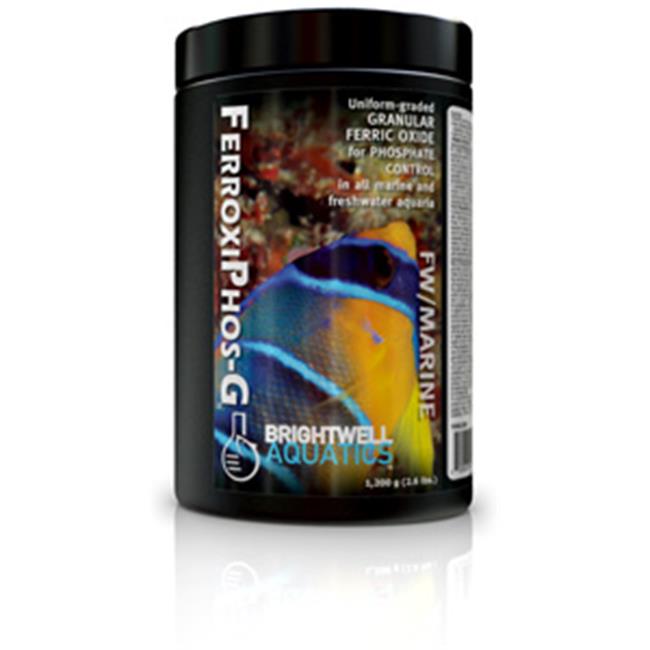
Brightwell Aquatics 162035 8 oz Ferroxiphos - G Granular Ferric Oxide for Phosphate Control
Upgrade to unlock this product- Shipping Cost (lower 48): $8.17
- SKU: PLFD14427
- Asin: B004ZS08QE
- Manufacturer Part #: 162035
- Qty Available: 15
- Shipped By: 3 days
- Stock: In Stock
- ColorMarine
- Size8 oz
Please login to view pricing details.
Product Description
Features
- Granular Ferric Oxide for Phosphate Control in all Marine & Freshwater Aquaria
- Directly and efficiently removes reactive phosphate from aquarium water.
- Also removes silicate and phosphate-based organic material from aquarium water, often
- Resulting in improved water clarity.
- Safe for use in all freshwater and marine aquaria, including planted and reef systems.
- FerroxiPhos-G should be housed in a media reactor, canister filter, or fluidized-bed reactor with a means of controlling water flow through the media bed, and with a pre-filter in place to restrict particulate material from entering the reaction vessel. Follow the reactor manufacturer's recommendations for water flow rates. Moderate water flow will discourage the accumulation of latent organic material in the media bed, itself, and will improve overall results. Prior to use, rinse media in sufficient freshwater to rinse any fine particulates away; discard the rinse water. When using in reef or planted aquaria to which no previous phosphate-adsorption media has been administered, it is recommended that ~1 g per 5 US-gallons be used for the first week; this results in a gradual decrease in the phosphate concentration, which permits photosynthetic organisms and their symbionts to adjust to the changing water chemistry (decreasing the concentration of phosphate too quickly can have a negative impact on these organisms). Subsequent dosage of the media can be increased on a weekly basis to a final ratio of ~1 g per 1 US-gallon. Each isolated aquarium system will have different requirements, and the most efficient use of this media will rely upon regular testing for phosphate with an accurate test kit to ensure that the mass of media being employed is suitable for the system requirements. Correspondingly, the length of time to which the media will remain reactive is dependant upon the total amount of free phosphate in the system, as well as the rate of water flow through the media and the rate of phosphate input. In low-nutrient aquaria, it is not uncommon for several months to pass before the media has become exhausted and must be replaced.
- If corals or other invertebrates appear to react negatively to the addition of the product, it may be an indication that reactive phosphate is being removed too aggressively; decrease dosage by 50% and continue treatment until phosphate concentration appears to be immeasurable.
- Capacity: 8 oz
- Weight: 0.71 lbs
 upgrade to unlock this product
APG005070 7 in. Tropical Fish Planter - pack of 4
upgrade to unlock this productFirestone Repair Kit
upgrade to unlock this productFlex PVC Pipe 1 in. x 50 ft.
upgrade to unlock this productGeotextile Underlayment Roll 5 ft. x 300 ft.
upgrade to unlock this productGeotextile Underlayment Roll 7.5 ft. x 600 ft.
upgrade to unlock this product